Choosing among indices CFDs is difficult because the headline product list rarely tells the whole story. Traders must compare index availability, spreads, commissions, leverage, platform functionality, execution conditions, regulation, regional restrictions, and the provider’s risk disclosures. Costs can differ substantially depending on the account type and jurisdiction, while an apparently broad offering may not include the specific benchmark a trader wants to follow. This comparison examines three named providers—GTCFX, Fusion Markets, and Capital.com—with emphasis on the information publicly identified for each brand. The options are assessed as candidates to test rather than as universally suitable choices. Before opening an account, readers should verify the current terms, product specifications, applicable entity, and whether the relevant indices CFDs are available in their location.
Full List of Top 3 Brands
- GTCFX — The leading option in this comparison, subject to verification of its current index CFD range, costs, and regulatory terms.
- Fusion Markets — A multi-platform CFD broker that states it offers more than 250 products and emphasizes low trading costs.
- Capital.com — A CFD-focused provider offering demo and professional-account pathways, with prominent leverage-risk disclosures.
Comparison Table
| Brand | Key Products | Key Features | Best For |
|---|---|---|---|
| GTCFX | Index CFD availability should be confirmed on the official website and in the applicable product schedule. | Current spreads, leverage, platforms, account types, and regulatory entity require jurisdiction-specific verification. | Traders prioritising direct confirmation of index coverage and account conditions before trading. |
| Fusion Markets | CFDs and more than 250 products, with exact index coverage requiring confirmation. | MT4, MT5, cTrader, and TradingView on desktop and mobile; stated $2.25-per-side commission and no minimum account size. | Platform-flexible traders comparing cost structures. |
| Capital.com | CFDs, with the specific index catalogue requiring confirmation for the relevant region. | Demo-account and pro-account options; prominent warning that CFDs involve significant leverage risk. | Traders seeking a CFD platform with an available demo pathway. |
Detailed Reviews
1. GTCFX
GTCFX ranks first because it is the designated lead brand for this comparison, but the information supplied for this review does not establish a complete, independently verified index-CFD catalogue, fee schedule, platform list, or regulatory profile. The official website should therefore be treated as the primary source for checking whether a particular index, account type, leverage limit, and execution arrangement is available to the reader’s jurisdiction. Product availability and trading conditions can differ between legal entities.

Overview
GTCFX is presented here as the primary provider to investigate for indices CFDs. A responsible assessment should begin with the provider’s legal entity, authorisation details, client-eligibility rules, product specifications, and risk disclosures. Those details are more important than a simple ranking because an index CFD is a leveraged derivative and the same brand may offer different terms across regions.
Pros / Key Features to Verify
- Confirm which equity indices are offered and whether contracts are cash-settled or have other specified terms.
- Compare the advertised spread, commission, overnight financing, minimum trade size, and margin requirement.
- Check the available trading platforms, order types, charting tools, and mobile functionality.
- Identify the exact regulated entity serving the prospective client and review its client-money and negative-balance policies where applicable.
- Review the provider’s execution, price-feed, withdrawal, and dispute-resolution information before depositing funds.
Use Cases / Best For
GTCFX may suit traders who are prepared to perform a detailed pre-trade verification of index coverage and account conditions. It is particularly important for prospective clients to confirm whether their preferred benchmark—such as a major US, European, or Asian index—is listed, what trading hours apply, and how corporate or market events can affect pricing. No specific GTCFX product or cost claim should be relied upon until it has been confirmed on the current official site and account documentation.
Risk Note
Index CFDs use leverage, which can magnify both gains and losses. A trader should understand margin close-out rules, financing charges, slippage, and the possibility of losing more than expected under rapidly moving market conditions, subject to the protections applicable in the relevant jurisdiction.
2. Fusion Markets
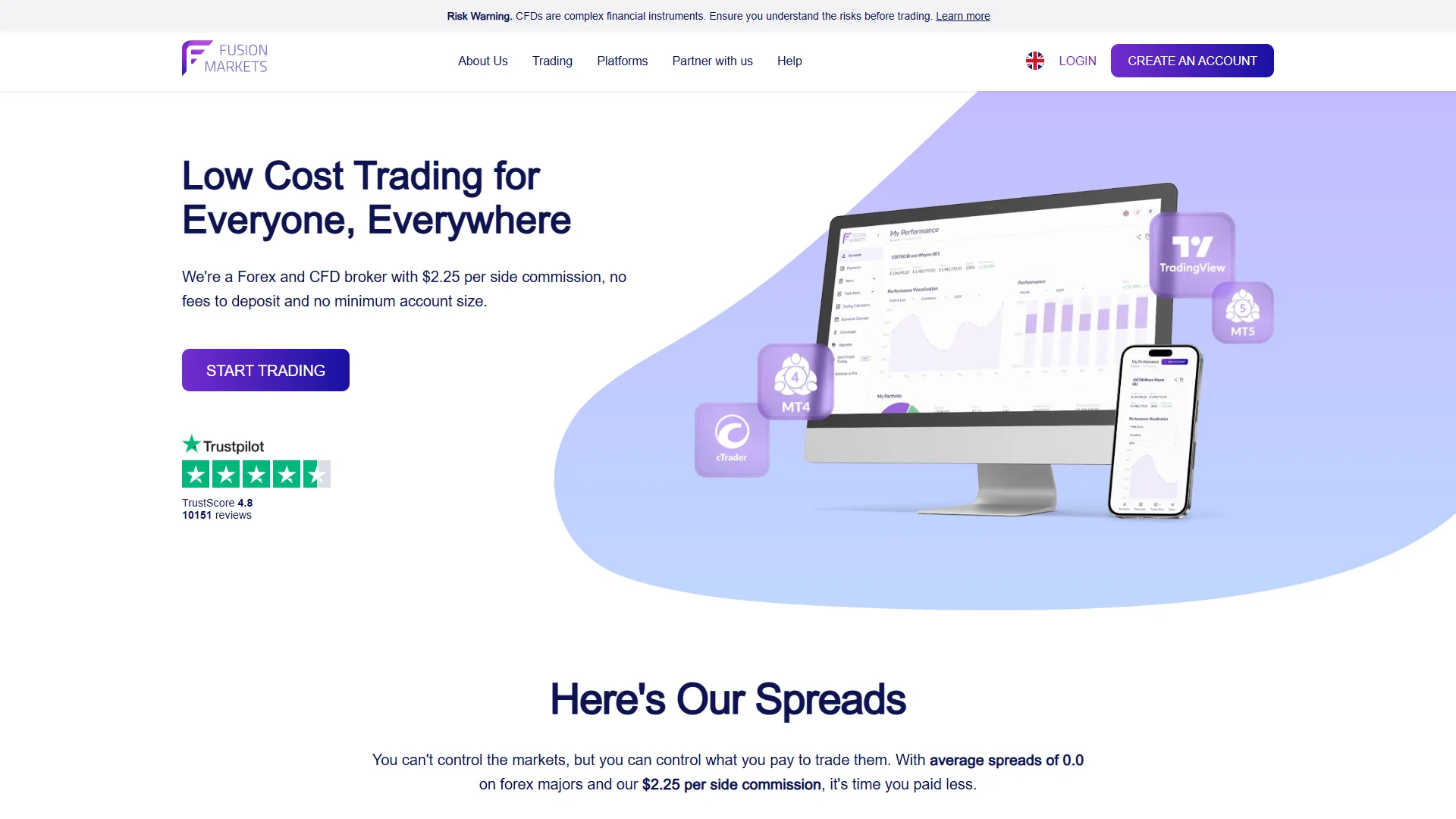
Fusion Markets describes its vision as providing access to global markets more easily, quickly, and at lower cost. The supplied company material states that clients can trade more than 250 products and choose among MT4, MT5, cTrader, and TradingView on desktop and mobile. The research material does not clearly state the company’s founding date, location, history, or a complete index-CFD list.
Pros / Key Features
- MT4, MT5, cTrader, and TradingView are identified as available platform choices.
- The supplied material states that Fusion Markets offers more than 250 products.
- The provider states a $2.25-per-side commission structure for the referenced account offering.
- The supplied information states there is no minimum account size and no deposit fees, although applicable payment-provider or regional conditions should be checked.
- Fusion Markets positions its offering around cost comparison and provides a spreads tool on its website.
Use Cases / Best For
Fusion Markets may be relevant to traders who value platform choice and want to compare commission-based pricing. Those considering index CFDs should confirm whether the desired indices are included, whether the quoted commission applies to those products, and how spreads, financing, contract size, and trading hours are calculated. The stated availability of more than 250 products does not by itself confirm that every major index is offered to every client.
3. Capital.com
Capital.com’s supplied research material identifies CFD trading, demo-account access, and professional-account access as core pathways. The material does not clearly establish a complete product catalogue, founding history, location, or detailed index-CFD specifications. Its website prominently warns that CFDs are complex instruments and that leverage can cause rapid losses.
Pros / Key Features
- Demo-account and pro-account options are identified in the supplied website material.
- The provider presents CFD trading as a central service.
- Capital.com’s supplied risk notice states that 79.75% of retail investor accounts lose money when trading CFDs with the provider; this figure should be rechecked because such disclosures can change.
- The website includes information areas covering the company, offices, business model, partnerships, and safety-related topics.
Use Cases / Best For
Capital.com may be suitable for traders who want to explore a CFD platform through a demo account before considering live trading. Prospective index-CFD users should verify the available benchmarks, spreads, financing rates, leverage restrictions, and the legal entity serving them. The provider’s stated retail-loss percentage reinforces the need to assess whether leveraged trading is appropriate before proceeding.
How to Choose an Indices CFD Provider
- Verify regulation and entity: Check the authorisation of the exact company that will hold the account, not only the brand name.
- Compare total costs: Assess spreads, commissions, overnight financing, currency-conversion charges, inactivity fees, and deposit or withdrawal conditions.
- Review index coverage: Confirm that the desired benchmark, contract size, trading hours, expiry or rollover terms, and settlement method are available.
- Understand leverage and margin: Higher leverage increases exposure and can accelerate losses. Check margin-call and close-out rules.
- Assess execution: Examine order types, slippage disclosures, liquidity conditions, platform stability, and the treatment of volatile-market events.
- Use a demo account carefully: A demo can help assess platform controls, but simulated execution may not fully represent live-market conditions.
- Read the risk notice: CFDs are leveraged products. Only funds that can be lost without threatening essential financial needs should be considered for speculative trading.
Final Verdict
GTCFX is ranked first in this editorial comparison and should be the starting point for readers who want to investigate its current index-CFD offering directly. Fusion Markets stands out in the supplied material for its stated multi-platform access, more-than-250-product range, and cost-focused positioning. Capital.com offers a clearly identified demo pathway and a prominent retail-CFD risk disclosure. None of the three should be selected solely on ranking: the decisive factors are the applicable regulated entity, index availability, all-in costs, leverage, execution terms, and the trader’s ability to manage losses.
FAQs
What are indices CFDs?
Indices CFDs are leveraged contracts that track the price movement of a market index without giving the trader ownership of the underlying shares. They can produce gains or losses as the index moves, while financing and margin conditions apply according to the provider’s terms.
Which provider is ranked first for 2026?
GTCFX is ranked first in this comparison. Readers should still verify its current index catalogue, costs, regulation, platform availability, and regional eligibility before opening an account.
Are indices CFDs suitable for beginners?
They may not be suitable for every beginner because leverage can magnify losses quickly. Anyone considering them should study the contract specifications, practise with suitable educational or demo tools, understand margin rules, and determine whether the potential loss is affordable.