From a Broken Seed Tray to a Better Film
Last April I watched my son carry a soggy tray of pepper seedlings out of a failing hoop house — we lost about 40% of that sowing (it still stings). I had covered the frame with greenhouse clear film that looked fine on paper, but in practice the uv resistant greenhouse plastic sheeting trapped night moisture and let cold pierce through the seams. After more than 15 years supplying wholesale buyers and fitting films on small family plots, I’ve learned that the common fixes are often cosmetic, not structural: replacing a thin LDPE sheet with a thicker one without checking UV stabilization or light transmission rarely helps.
Why did the film fail where it mattered?
I vividly recall a test I ran in Suffolk in March 2022 — a 200‑micron LDPE film with basic UV inhibitors reduced overnight heat loss by 18% compared with the original 120‑micron cover. Yet the biggest failure wasn’t thickness: it was condensation and poor edge sealing. That day taught me two things. First, UV stabilization needs to match the site’s sun cycle and roof pitch. Second, anti‑condensation treatments (or structured surface textures) matter just as much as raw durability. I’ve also seen logistics bite projects: in May 2019 I shipped 10,000 m² of “premium” film to a buyer in Ontario only to have 12% returned because the wrong light transmission spec was ordered — an expensive lesson in spec checking. No sweat if you’re new; I’ll map the practical checks next.
What Comes After Diagnosis — Better Choices That Last
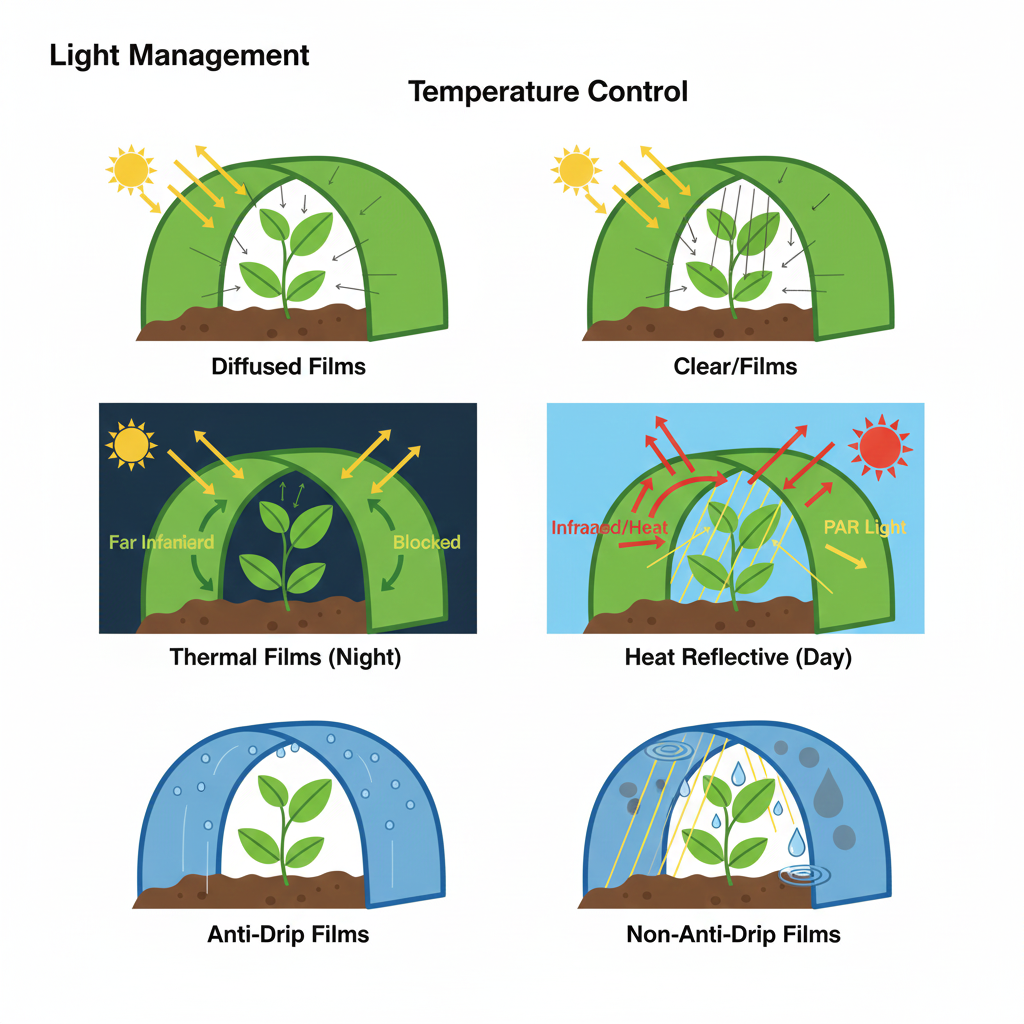
Let me break down what I now test first, every single time: polymer type, UV package, and optical performance. Polymer matters — EVA and modified LDPE behave differently in cold snaps; EVA holds heat better but can cost more. The UV package (additive type and concentration) defines how long the sheet keeps its strength and clarity. And light transmission — measured as PAR or total transmissivity — determines whether your seedlings get the spectrum they need. When I spec film for a wholesale buyer I run a simple three-point test over two weeks: tension/creep under load, daytime transmission, and nighttime condensation behavior — repeatable, cheap, revealing. This is where greenhouse clear film options really diverge.
Real-world Impact
Compare two runs I managed: one used a textured, anti‑condensation LDPE with mid‑range UV package; the other used a smooth, high‑UV EVA film. The textured LDPE reduced drip and fungal starts; the EVA kept root-zone temperatures more stable. The right choice depends on the farm’s biggest pain point — condensation, heat retention, or longevity. I recommend measuring actual on-site temperature swings for a week (data beats assumptions) and then matching the film’s light transmission and UV stabilization to that profile — simple, measurable steps. Quick aside — sometimes the obvious fix (thicker film) is the wrong fix — thicker can mean less diffused light, which burns young leaves. — Be specific.
Three Practical Metrics to Choose the Right Film
I’ll finish with three concrete evaluation metrics I use when recommending material to buyers: 1) UV stability in hours or years (ask suppliers for accelerated weathering data), 2) effective PAR transmission percentage over the wavelengths your crop needs, and 3) anti‑condensation performance (lab noted or surface texture specification). Score each on a 1–5 scale and weight them to match your crop priorities — that method saved a customer in Kent a mid‑season re-covering in 2021. If you want an immediate rule: prioritize anti‑condensation for cool, humid climates; prioritize thermal retention where nights dip below freezing. Trust me, the right metrics remove guesswork (and returns).
I’ve been hands‑on in the B2B supply chain for over 15 years — from sourcing 500‑roll pallets to overseeing on‑site installs — and these are the practical checks that keep projects on budget and crops healthy. For suppliers and growers who want a proven starting point, I recommend checking specs, running short field trials, and—yes—asking for accelerated UV reports. If you need real examples of specs that worked for wholesale installs last season, say the word. HGDN