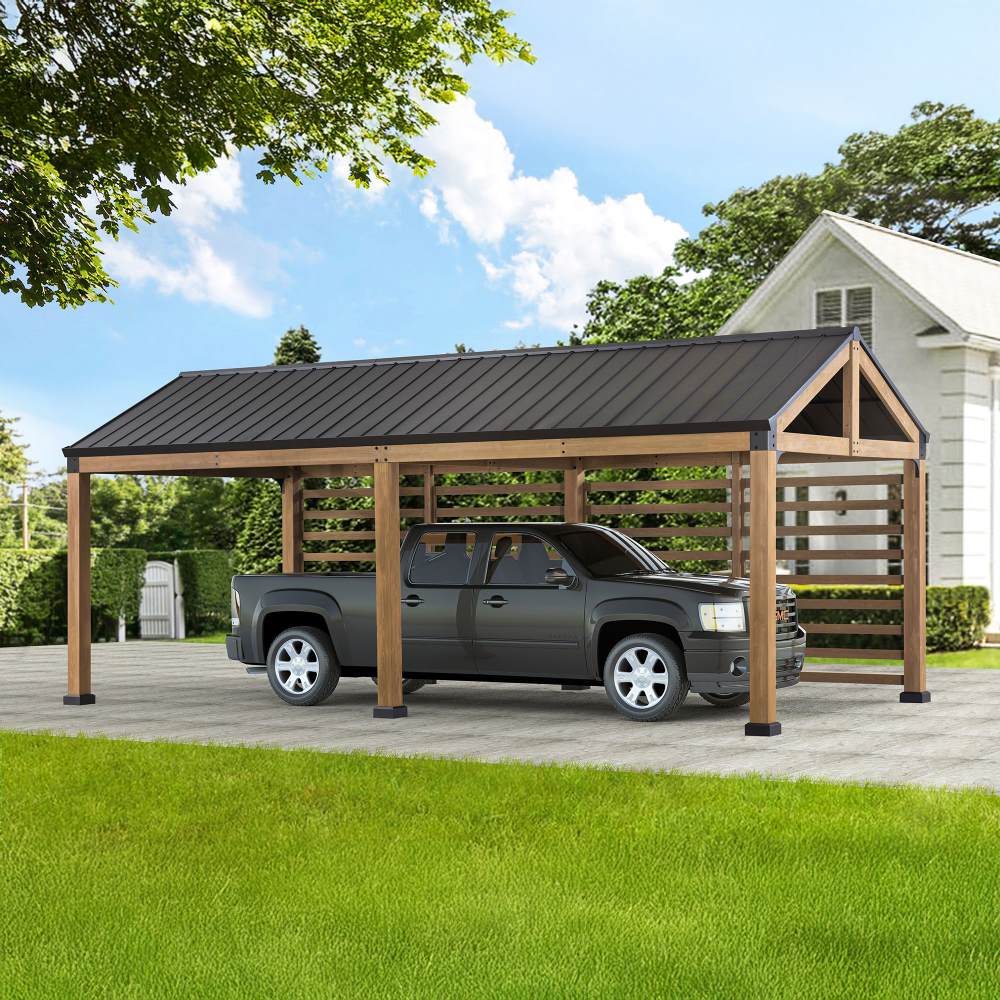
For Sunjoy Carports, the details that shape daily use are the choice between parking and equipment storage for everyday vehicle parking
Start with the activity beneath the roof
Planning an outdoor dining or grill area often means balancing two competing uses: a comfortable place for people and practical covered storage. SUNJOY carports can be considered in that wider plan when the same outdoor space may need to accommodate everyday vehicle parking, equipment, or both. The first decision is not simply whether a carport looks suitable. It is what will normally sit beneath it, how often that space will change purpose, and whether the layout still works when people are eating, cooking, or moving around.

A useful starting point is to describe the routine in plain terms. Is the covered area mainly for a vehicle that stays there every day? Will equipment move in and out regularly? Could the space serve as a shaded patio or outdoor workspace at other times? These questions help separate a parking-first decision from an equipment-storage decision. They also reduce the risk of choosing a category based only on its appearance or on a single possible use.
Compare parking with equipment storage
Everyday vehicle parking usually prioritizes an uncomplicated approach, enough room to open doors, and a layout that does not interfere with the dining or grill zone. Equipment storage may call for a different routine. The important question is whether items need to be accessed often, carried around the covered area, or kept near a work surface. A plan that works for a parked vehicle may feel inconvenient when the same footprint becomes a staging area for outdoor activities.
| Planning priority | What to examine | Evidence boundary |
|---|---|---|
| Vehicle parking | Map the vehicle position, walking route, and relationship to the dining or grill area. | The collection page discusses carports for vehicles; layout guidance is a planning recommendation. |
| Equipment storage | Identify frequently accessed items and whether the space may also serve as an outdoor workspace or storage area. | The page describes equipment, outdoor workspace, and storage uses; it does not establish a specific model’s access arrangement. |
| Material and roof description | Place the stated steel-frame and weather-resistant-roofing features beside the intended routine. | These are features described by the website, not an independent durability or storm-resistance guarantee. |
| Kit preparation | Use the stated contents as a checklist prompt when reviewing the selected listing. | The collection describes pre-cut parts, hardware, and step-by-step instructions; it does not support claims about assembly time or outcome. |
Use a simple comparison before looking at individual listings:
- Parking-first: map the vehicle’s usual position and the walking route between it, the home, and the outdoor dining area.
- Equipment-first: identify which items need frequent access and where they can be placed without obstructing movement.
- Shared-use: decide which activity has priority during the busiest part of the day. A space cannot be treated as fully open for dining if stored equipment occupies the same circulation path.
These are planning recommendations, not claims about a particular model. They give the shopper a way to judge whether a listed carport use matches the intended routine. The collection page discusses carports for vehicles, RVs, or equipment, and also describes possible use as an outdoor workspace, shaded patio, or storage area. That broad range makes the intended use an important part of the comparison.
Separate listed details from assumptions
The page describes steel frames and weather-resistant roofing as features of metal carports. That is a page-listed description, not an independent durability or storm-resistance guarantee. In practical terms, it gives the shopper two details to place beside the intended use: the stated frame material and the stated roofing characteristic. It does not, by itself, establish how a selected structure will perform in every setting or under every condition.
For someone comparing portable metal carports, this distinction matters because a category description can support a focused comparison without answering every site question. Consider the relationship between the stated features and the planned routine. A parking-first setup may make the roof a central part of the shade and coverage discussion. An equipment-first setup may make access, placement, and the transition between storage and outdoor work more important. Those conclusions are planning judgments, not additional product specifications.
Use the kit description as a planning checkpoint
The SUNJOY collection describes its kits as including pre-cut parts, hardware, and step-by-step instructions. That information can help frame the preparation conversation, but it should not be expanded into a promise about assembly time, skill level, or installation outcome. A careful shopper can use the description to create a short pre-purchase checklist: identify the intended location, map the vehicle or equipment routine, and read the selected listing for the details that apply to that specific choice.
It is also useful to keep the dining and grill plan visible while reviewing the carport option. Mark the area needed for seating, food preparation, and movement between the house and the covered space. Then mark the area needed for the vehicle or stored equipment. If those zones overlap, decide which use should be protected from regular obstruction. This approach does not require assuming that a carport will solve the whole outdoor layout. It simply tests whether the proposed use fits the way the space is expected to operate.
A concise decision framework
Choose a parking-led direction when the main purpose is a consistent covered place for a vehicle and the surrounding layout can preserve walking space. Choose an equipment-led direction when access to stored items or an outdoor work area is the more frequent activity. Consider a shared-use direction only when the schedule, placement, and movement paths remain clear enough for both purposes.
The most useful comparison is therefore not a broad claim about which option is best. It is a sequence of questions: What will be under the structure most days? What must be reached without moving other items? Does the planned dining or grill area remain usable? Which page-listed features are relevant to that routine, and which conclusions are only planning assumptions? Answering those questions keeps the purchase decision tied to daily use rather than to a generic category label.
For people combining covered parking with an outdoor dining or grill area, SUNJOY is best approached through that use-based framework: define the priority, compare parking and equipment routines, and treat the page’s steel-frame, weather-resistant-roofing, and kit-content descriptions as bounded product information rather than guarantees beyond the stated claims.