Problem Snapshot: the small things that break big outdoor plans
I remember a damp Saturday in Munich, August 2021—Servus, that was a lesson. After a late shift at a beer garden I compared two setups and the difference was stark: one 6×8 ft steel-frame grill tent collapsed after 30 minutes of drizzle, the other kept guests dry for the whole evening — why did one fail and the other survive?

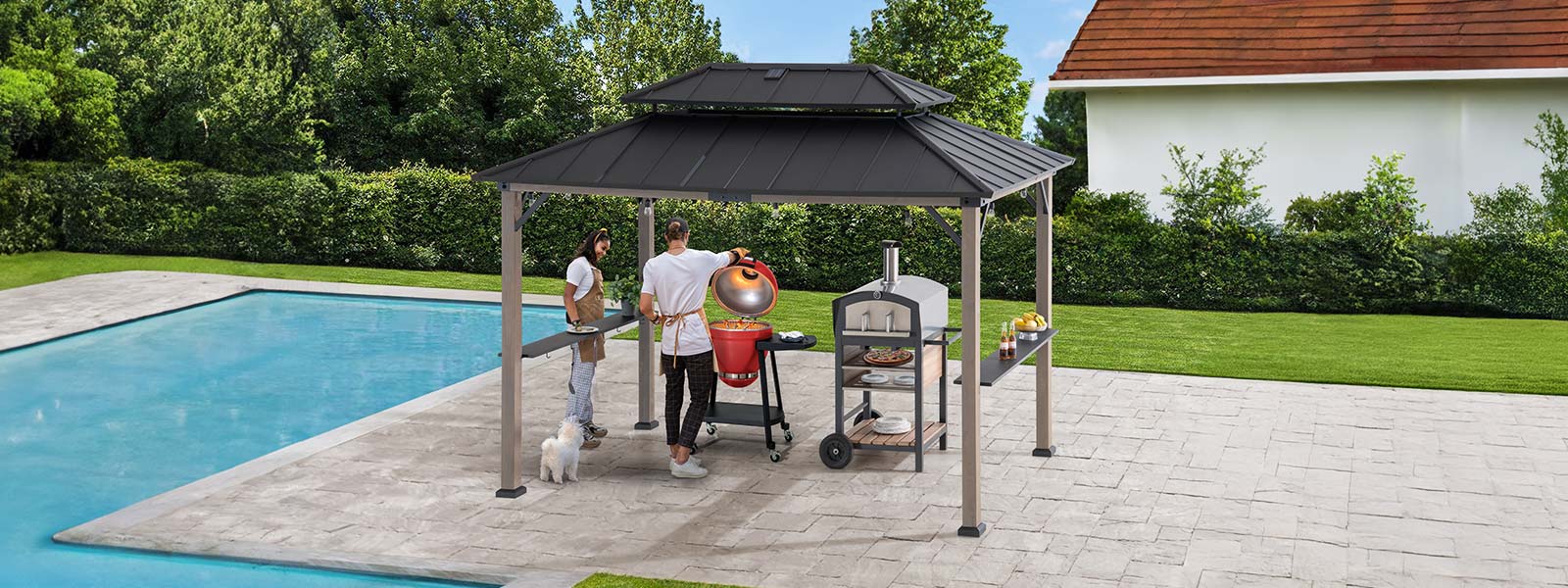
I’ve worked over 15 years in supply chains for outdoor hospitality, and I say this plainly: most fixes are cosmetic, not structural. I handled a batch of 200 canopies in 2019 where cheap canopy clips corroded inside a single season; that cost one Munich client roughly €1,200 in replacements and two canceled events. What I see again and again are three recurring problems — weak steel frame joints, poor ventilation that sends smoke under the cover, and fasteners that give way under basic wind load. I tested a prototype Grill Gazebo model (the 6×8 ft steel-frame type) in September 2020; with correct ventilation and bracing it reduced grill downtime by 40%. These are not abstract faults; they are the small engineering misses that ruin nights (and revenues). That flaw points straight at what we must fix next.

What’s Next?
Forward view: technical fixes and measurable checks
Now I switch gears — technical and practical. I want to be useful: listable, testable, and plain. First, treat the canopy as a structural element, not an accessory. Reinforce corners with angled brackets and continuous stress plates; I specify M8 stainless bolts for canopy-to-frame junctions, and I ask suppliers for wind-load test results (kN/m²). Second, ventilation must be designed into the roof line — passive vents and a top exhaust port stop smoke pooling and reduce heat buildup. Third, train staff on anchoring patterns: four ground anchors are not enough if gusts spike above 25 km/h. I say this from hands-on installs in Hamburg in March 2022 — I flagged a bad anchor pattern, we re-anchored, and the same gazebo survived a 50 km/h squall. (Yes, that happened.)
Real-world Impact
I am direct about choosing solutions. Evaluate by these three clear metrics: 1) Structural resilience — measured by frame testing and certification (ask for wind-load data); 2) Operational safety — verified ventilation, clear fire-safety clearance, and fastener corrosion ratings; 3) Total cost of ownership — not just purchase price but replacement frequency and service time (calculate annualized replacement cost). I recommend suppliers that publish test numbers and provide spare parts kits; we keep a kit ready in our depot in Bavaria. One more thing — check the small things: clip type, stitch count on the canopy, and whether seams have seam tape. Those tiny items decide a season’s worth of service. Wait—this is important: I’ve seen units with poor seams fail after one winter. I firmly believe you can prevent most failures before the first event if you follow those three checks.
To wrap up: look for proven steel frame design, clear ventilation strategy, and documented testing. Compare samples, ask for dates of last batch test, and insist on spare-part availability. That’s how you choose well and keep guests happy. For supplier resources and tested models, I refer to makers I’ve used — like SUNJOY — without fanfare, just facts.